WELCOME BACK to the final installment our introduction to autocross (autoX). The first article explained what the activity is and hopefully provided the hook to get you to want to participate, whether that is to have fun in a safe environment or to prove to the BMW club that we are the better drivers. The second article outlined what you needed to do to be prepared from a few weeks before the event, to loading your car the day before, to the registration process. This last article will provide information on how to have fun and do your best at an autoX event.
So, now that you are registered and the busy registration desk has vaguely pointed you towards a large piece of asphalt with a random collection of traffic cones, the fun really starts. The first thing to understand is there is a pattern to the cones. The best way to learn how to successfully navigate the course is to walk the course.


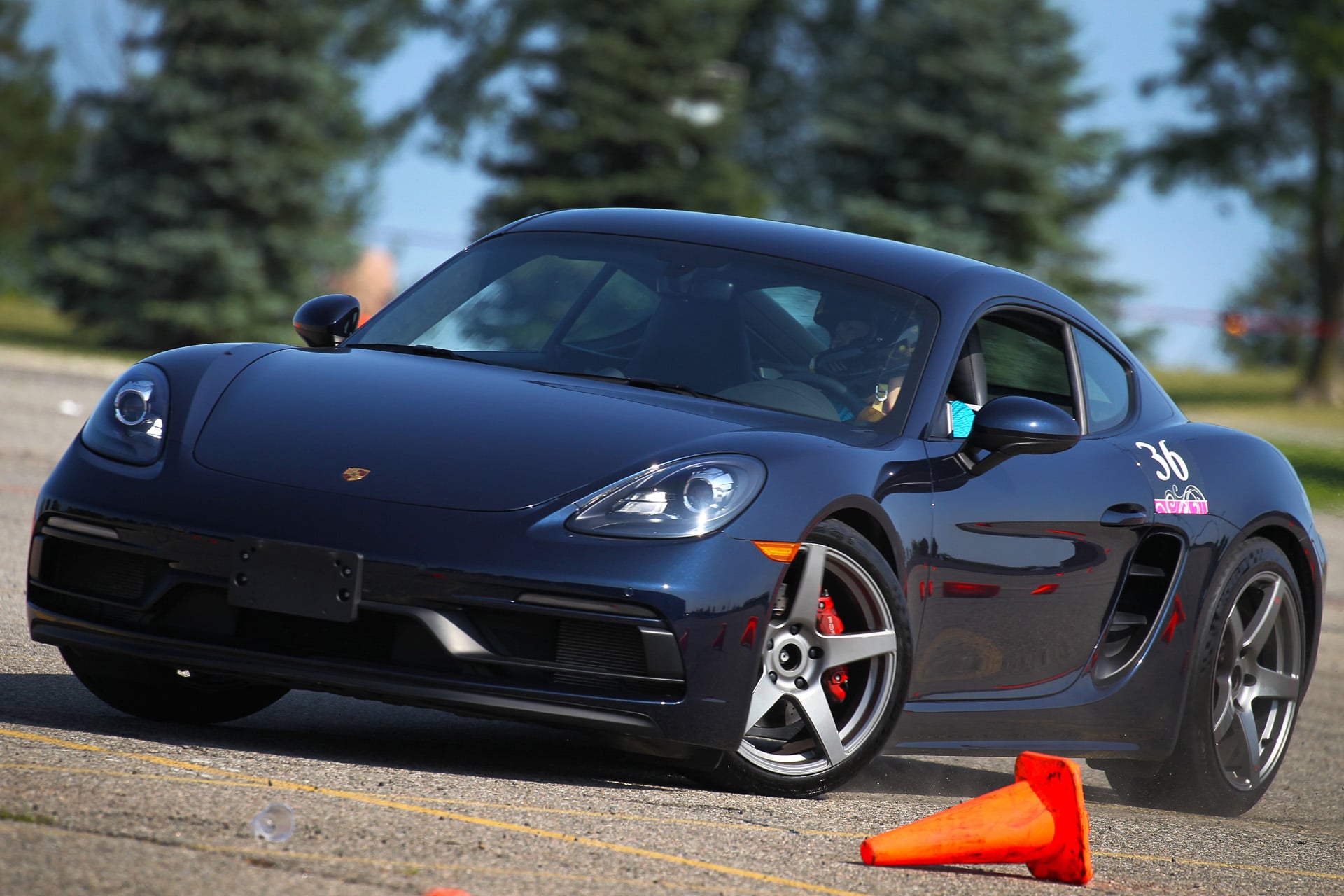

There are a limited number of runs that you will be allowed in an autoX event and there is no practice prior to your first timed run. Walking the course prior to the runs is how participants learn the course and most events will have the course open for walking 30-60 minutes before the drivers’ meeting. All the cones out on the course tell you something. A pair of upright cones that are wide enough for a car to travel through represent a gate that you have to go through. Double cones on each side mean you will pass through that gate twice. A cone lying on its side indicates a direction. For example, a cone pointing to the right indicates that you need pass that cone (and its upright friend) on the righthand side.
There is a lot of information to absorb as you walk the course, including where the course starts, the turns and where the course ends. Learning the course at your first few events can be a challenge. A good strategy can be to follow other competitors on their walk through, or ask a fellow competitor if you can walk the course with them. If possible, walk the course multiple times varying your focus for each walk through. This does mean being at the event early enough that you have the time for multiple walks.
Use the first walk through to get a feel for the flow of the course and where it is going. During this walk, you are working to keep a broad focus of how the course is laid out. Are there longer straights, tight corners, areas you need to brake heavily, and crucially, where does the course start and end?
The 2nd walk is where you start to determine where you want to place the car on the course. This will mean that you start to go from a broad focus to a more detailed scan of the course. Some of the items you want to look for include:
What makes a good visual reference? Like all good driving, vision is the key to success. Pick something that is not going to move! Identifying a specific cone as a reference may work, but there is a risk that it gets hit and not replaced and now what you are looking for isn’t in the correct spot.
Is a particular gate wide or narrow? This will define how fast you can come through the gate, and if you can move through it at an angle to set up for the next gate.
Is there any elevation change? Uphill will generally let the car brake and turn better. Downhill means less effective braking and more chance of the car losing traction in a turn (e.g. oversteer or understeer).
Will you need to change gears? Try to anticipate which gear you will be in at various points, and where you would want to change gears.
Is there a bump that could upset the balance of the car or a patch of asphalt that could have a different amount of grip?
In some cases, you will have enough time to walk the course more than twice. Where there is that opportunity, you can use that time to refine the thoughts you’ve developed. One of the things that can be helpful in later walk throughs is to see if the other competitors are looking at different things on the course. This can help you identify an area that may be more technically challenging than you first thought, and you may want to look over that area again. Another option is to ask questions of your fellow competitors about the course and what they would suggest for an approach to a particular section. Grassroots motorsports events are filled with people who want everyone to have fun and sharing advice and techniques with competitors ensures that people continue to participate.
The goal of the walk through is to learn the course well enough that you can remember the entire course. A strategy that you will see frequently is competitors tracing the course out on paper. This helps them remember the course, and it allows them to identify key information like a tight turn, a brake zone, or the need to be patient before accelerating. Another technique that takes more practice is to visualize the course. This builds on the idea of drawing the course, but now you need to have learned the course well enough to close your eyes and picture the entire course. Any place where you have trouble remembering indicates that you may want to spend a bit of time and review that particular section again. This is a skill that will take some practice, but will lead to the best possible results. If you ever watch skeleton, bobsleigh or luge, you will see all the pilots with their eyes closed and swaying at the top of the run. They are not dancing to the music, but instead visualizing the entire run.
Before the first car is released, a drivers’ meeting is held. The meeting is an important part of keeping everyone safe throughout the day. The organizer will cover the most important rules for the day, including driver and car safety rules, where it is best to watch the cars on course, where the cars will line up prior to their runs, and where you will safely, slowly exit the course after you finish your run. The organizer will also explain the order of cars running and when drivers will have to marshal (e.g., pick up knocked over cones and ensure the event remains safely run). This meeting is also a good opportunity to ask any remaining questions you may have about the event.
You are all safely buckled in, helmet properly strapped on, car settings adjusted, and it is finally time to drive! This is likely when you get a big dose of nervous energy. This is completely normal, and it is merely a physical symptom of the excitement you are feeling. Before you start the car, take a deep breath in, hold if for a few seconds and fully exhale. Repeat that as needed. This will help settle any nervousness and stabilize your heart rate. It is also a good idea to repeat this breathing exercise just as you pull up to the start line.
You have brought your car to the start line and are waiting for the starter to release you on your first run of the day. Expect your first run to feel different than you thought on your walk through. Apparently, driving at 40 -70 KPH leaves a different impression than walking. The way to address that difference is to be slower than you think you need to be to complete the run, including gently accelerating from the start line. By completing the course, you learn more on each run. The biggest challenge with autoX is you have only a limited number of runs that are timed. If you get lost, you reduce the opportunity to build confidence, so you can improve on subsequent runs. You can also use this first run to learn what gear may be best for various parts of the course, and if you are going to shift during the run. If you didn’t get a time for a run, it likely means that you missed passing through one of the gates – feel free to ask where you got lost so you can get it correct on the next run.
On each of your subsequent runs, work on gradually increasing your pace as you become more comfortable with the course. A good goal is to reduce your time for each run as this can give you a good sense of improvement. Try to avoid comparing your times to the more experienced competitors. They may appear to be pushing right from the beginning, but they might have hundreds of runs completed on an autoX course. Their cars may also be better optimized for the event, based on their experience.
For those new to autoX, the best recommendation is to set your tire pressure to match the label on the door frame and leave the traction control/stability control active (if your car has those features). This provides a solid, safe and predictable handling car. As you gain experience, you may wish to change the tire pressures to see how that impacts the car’s handling and the time at an event. The first step is to see if you are using all of the tread. Clearly, you can’t hang out the window to look at the tire and watch where you need to go, so simplest solution is to use some sidewalk chalk and rub that on the tire across the tread and the sidewall. Complete your run and then look at where the chalk has been rubbed off. If there is still chalk left on the shoulder of the tread, the tire pressure can be lowered. If the chalk has been rubbed off the sidewall, the pressure is too low. If you make a change, do so in small increments (roughly 1 psi at a time). Also, it is best to keep a logbook and write down the pressures and how the car felt. That way, at the next event you can build off what you did last time. Also, remember that by changing the tire pressure you can alter the dynamics of the car. This could be by increasing the tendency for your car to oversteer, but usually by sacrificing acceleration (e.g., increase rear tire pressure); or give extra grip to accelerate, but by making the car understeer (e.g., reduce rear tire pressure).
As for traction control/stability control systems, these can be viewed as a hindrance, or a learning tool. If one of the systems steps in, it means you made a mistake that the car corrected for you. Examine the situation and determine what you could change to keep the system from intervening. Usually, these systems will act when you make a sudden input to the throttle or steering wheel. In your next run, see if you can be smoother and keep the system from activating. Disabling your traction control/stability control systems should be considered based on your level of experience, performance capability of the car and where you think there will be an improvement by turning it off. In modern cars, a skilled driver is faster with the systems left on because they can make independent adjustments to each wheel.
The following are strategies that you can use to improve each of your autoX runs:
What makes a good visual reference? Like all good driving, vision is the key to success. Pick something that is not going to move!
Keep looking where you want the car to go. Look where you want the car to be in 3-5 seconds. As autoX events feature some very tight corners, it may mean turning your head and even looking out the side windows to see where you want to go.
Watch your competitors complete a run. This is particularly helpful if there is a car that is similar to yours as it gives you information about the line, where the car accelerates, brakes and any gear selection.
Ride with a competitor (if allowed by the series). Ask an experienced competitor to ride along with them for a run. This will give you an idea of what you can work towards and give an idea of where you may need to modify the timing of when you brake or turn.
Ask a competitor for advice. You could ask about a specific section of the course that you are having difficulties driving through, or more general, what that person thinks the key to a successful run includes.
Take advantage of any coaching that is available. Some events will advertise coaching is available and this is usually reiterated during the drivers’ meeting. The people coaching are experienced and can help you identify the one or two actions that you need to work on to improve. If the event doesn’t specifically have coaches available, ask the organizers or other competitors if there is anyone willing to jump in and provide pointers.
Have Fun! You’re at the event to have fun. AutoX events are all similar in that the top prize is bragging rights, and I can guarantee you that Roger Penske is not watching to see who he will pair with Matthew Campbell in the Porsche 963 for the IMSA races. Stay positive and know that like any other complex task, it will take practice to improve, and the key is to identify what you are doing well. This can be related to how well you remembered the layout of the course, to feeling more comfortable with hard acceleration or braking or getting that one tricky corner correct. Try to focus on how you feel driving and not your run time or how your time compares to anyone else. Some people at the events are very experienced and very fast. Applaud their skill and aspire to match it. We can guarantee they weren’t fast at their first event.
If you have made it this far through the series of articles on autoX, you are likely at least somewhat tempted to come try. As mentioned in the first article, there are a few different series that compete in Ontario. The BMW Trillium/PCA UCR event is one of the smaller, more relaxed events and is a great place to try out autoX. If you get hooked, there are regional and even national level events to prove your skill against experienced competitors. </>
Photography by Ken Lin